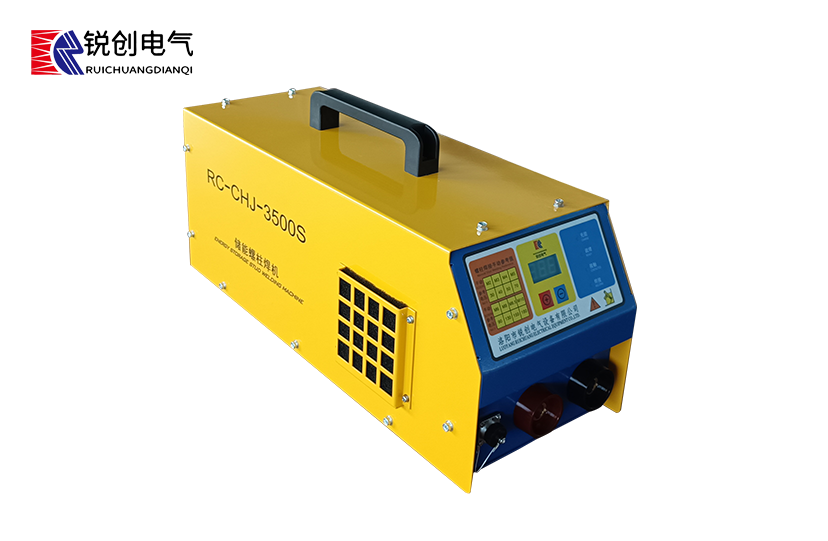
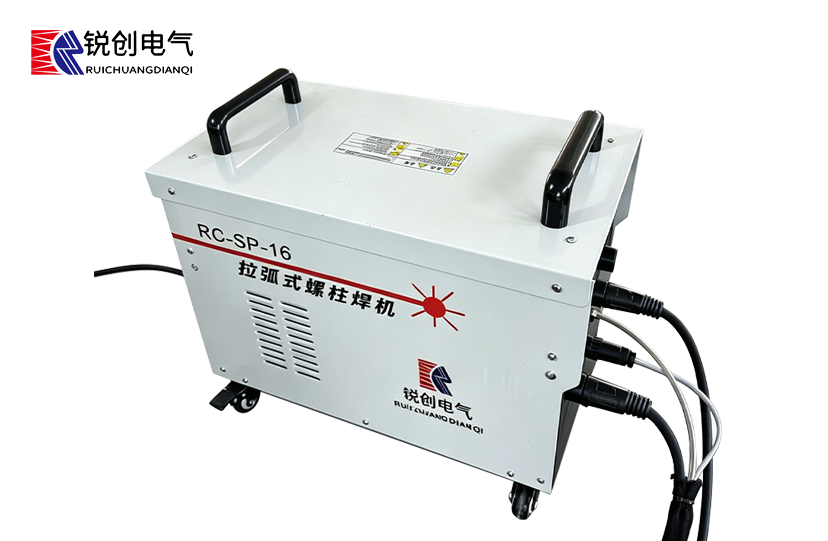
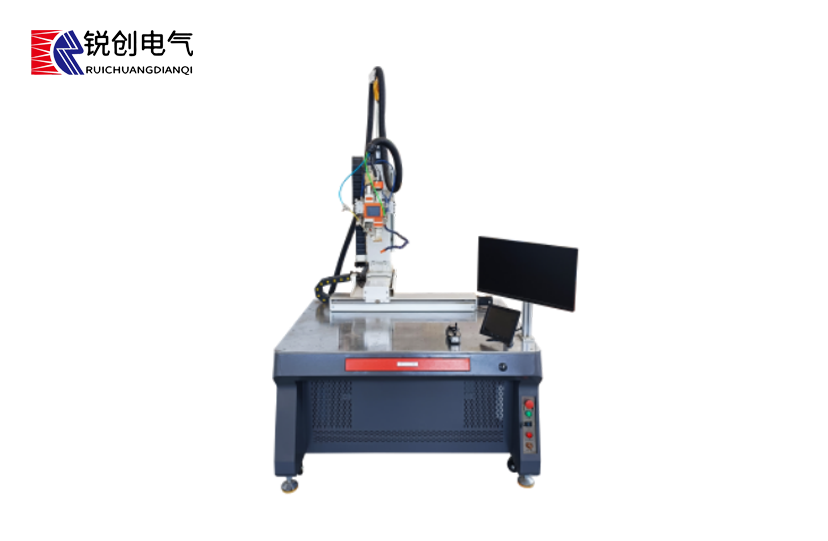
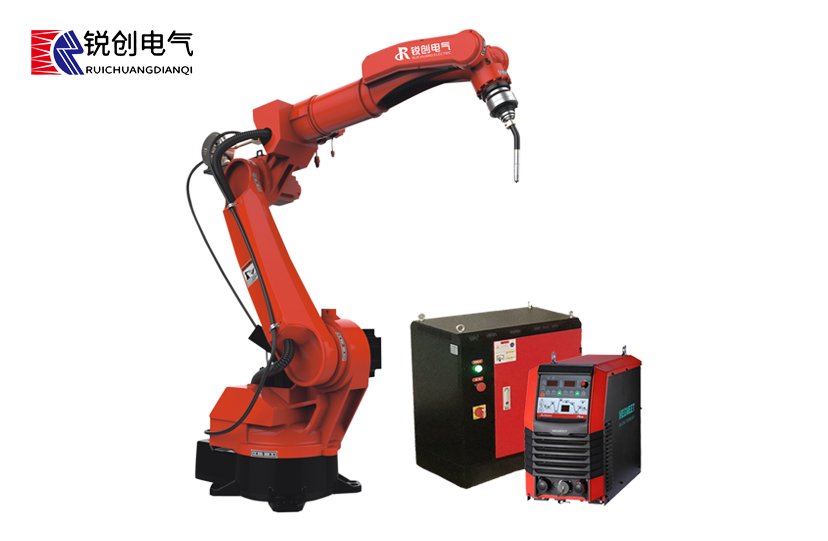
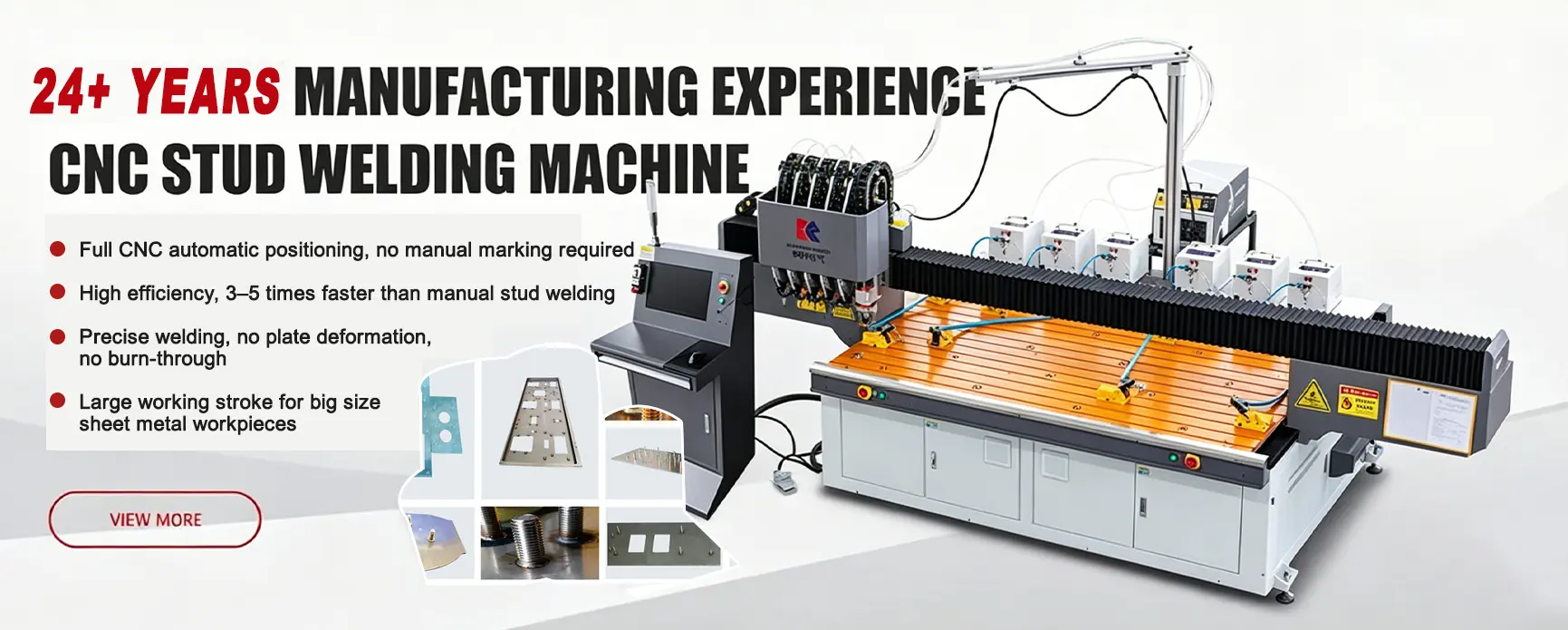
CNC Stud Welding Machines
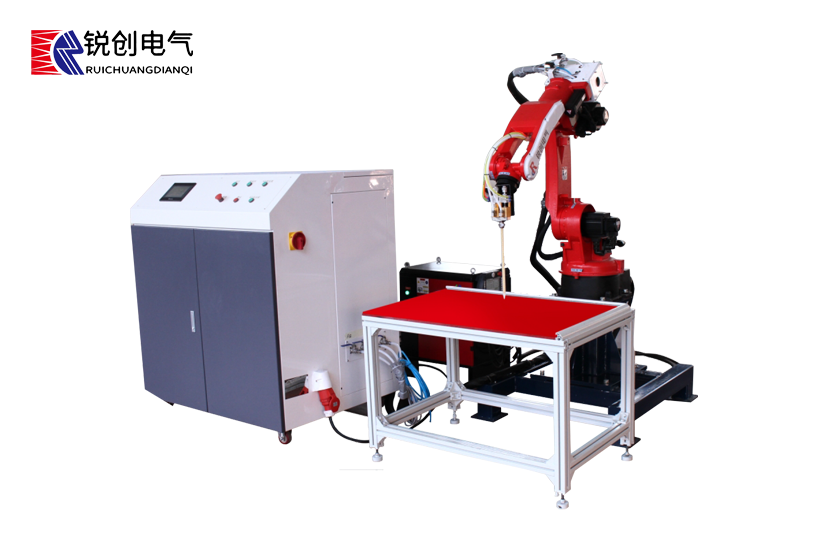
Technology: CNC Automatic Stud Welding System
Welding Range: M2–M10 Studs, 5–210 mm Length
Working Area: Available in different sizes for various sheet metal applications
Features: High-precision positioning, automatic welding, and improved production efficiency
Application: Sheet metal fabrication, electrical cabinets, automotive components, and industrial enclosures
Certificate: CE, ISO9001
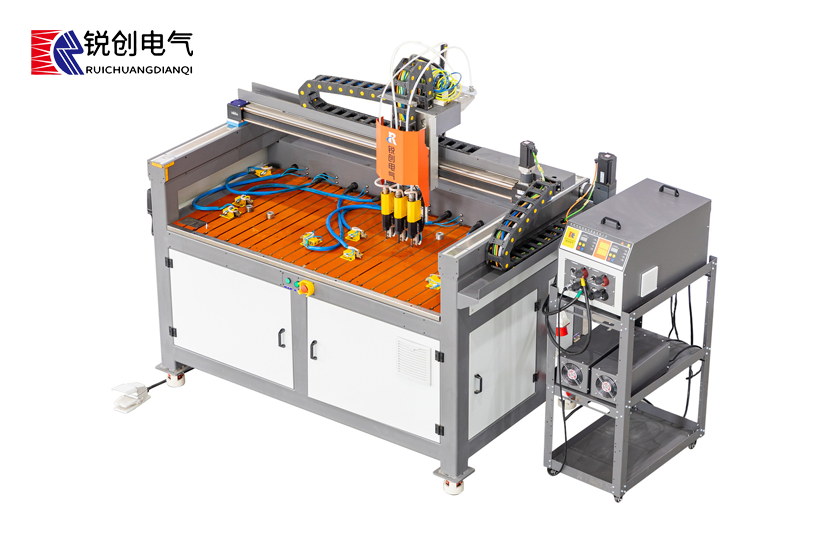
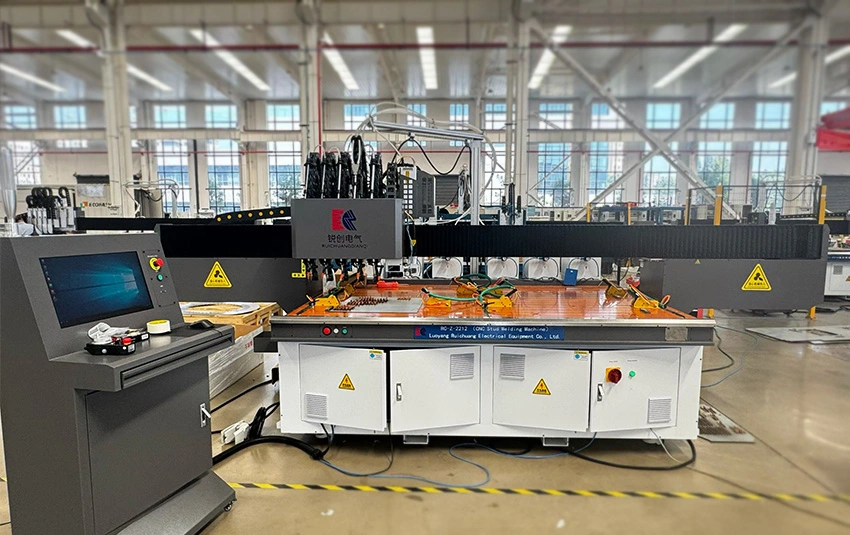
RC-Z-2212 CNC Stud Welding Machines for Sheet Metal Fabrication
Manual stud welding is a frequent challenge for manufacturers operating high-volume enclosure, cabinet or sheet metal lines, creating variance, reducing productivity and marking surfaces. The CNC Stud Welding Machines of Ruichuang's RC-Z-2212 series are designed for this very purpose – they combine the servo-driven multi-axis positioning with Capacitor Discharge welding to position M2–M10 studs with a precision of ±0.05 mm, at rates of up to 60 studs per minute, without any reverse-side marking.
What Is a CNC Stud Welding Machines?
An automated CNC stud welding machine uses Capacitor Discharge (CD) or Drawn Arc welding technology to weld studs, pins, or standoffs onto a base metal workpiece using a multi-axis CNC interface.
CD welding can handle thin materials and M10 sizes. It does not mark the reverse side, making it ideal for enclosures and cabinets that must retain outside surface quality. Drawing Arc welding is utilised for structural applications that demand deeper penetration and wider studs.
These machines with 10 and 15 axs motion control eliminate pre-drilling, tapping, and manual stud placement with optional vibratory bowl feeding. This reduces labour time per part and thermal distortion in thin-gauge sheet for fabricators who make many similar parts.
Key Technical Specifications
| Device Model | RC-Z-4-1612 | RC-Z-2212 | RC-Z-2-3012 | RC-Z-2-3015 |
| Working Stroke(X*Ymm) | 1600×1200 | 2200×1200 | 3000×1200 | 3000×1500 |
| Welding Type | Direct/Tilted feed welding torch, Incliined automatic torch | |||
| Number of Welding Torch | standard 1-3, 4-6, Customized | |||
| Stud Feeding Method | Automatic stud feeding | |||
| Number of Control Axes | 3 | |||
| Drive Method | servo motor + pneumatic | |||
| Welding Speed | 20-35pcs/min | |||
| Stud Diameter/mm | M3-M8, can be customized | |||
| Stud Length/mm | 8-35 mm, can be customized | |||
| Number of Mobile Clamps | Mobile 4/6/8pcs | |||
| Energy Storage Welder | 1 set | |||
| Welding Accuracy | ±0.15mm | |||
| Repositioning Accuracy | 0.02mm | |||
| Working Power Supply | 380V/50HZ | |||
| Frame Structure | Gantry | |||
How the RC-Z-2212 Works in Production
Automated positioning and welding in one cycle
The RC-Z-2212 offers positioning, feeding and welding in one continuous CNC cycle. The system travels to each preset coordinate, feeds the stud, fires the weld and proceeds to the next, without human input between stages when a program is loaded. This means that uniformity does not rely on the expertise of the individual welder, as it does with manual or semi-automatic equipment.
Servo driven precision of ± 0.05mm
Servo-motor powered welding heads and CNC controlled axis movement allow each stud to be placed within a tolerance window of ±0.05 mm. This degree of repeatability lowers downstream fitting difficulties on complicated sheet metal assemblies where many fasteners must be aligned with matching components.
Multi partite programmable routes
The system holds a number of welding programs, each corresponding to a distinct lay-out of the workpiece. It removes the need for physical retooling when switching programs, therefore reducing the changeover time when producing mixed production schedules.
Controlling heat input in CD welding
Energy is released in milliseconds in the CD welding process. The resultant heat impacted zone is limited and the base material surface on the opposite side is free of marking or deformation. This is especially important for galvanised, powder-coated or pre-finished sheet metal, when rework of the surface is expensive.
Consistent weld parameters per cycle
Each weld is made at the same preset voltage, plunge speed and contact pressure. One of the key reasons fabricators switch from manual welding to this sort of automated system is the constancy of the parameters throughout large cycle counts.
Compatible Materials & Typical Applications
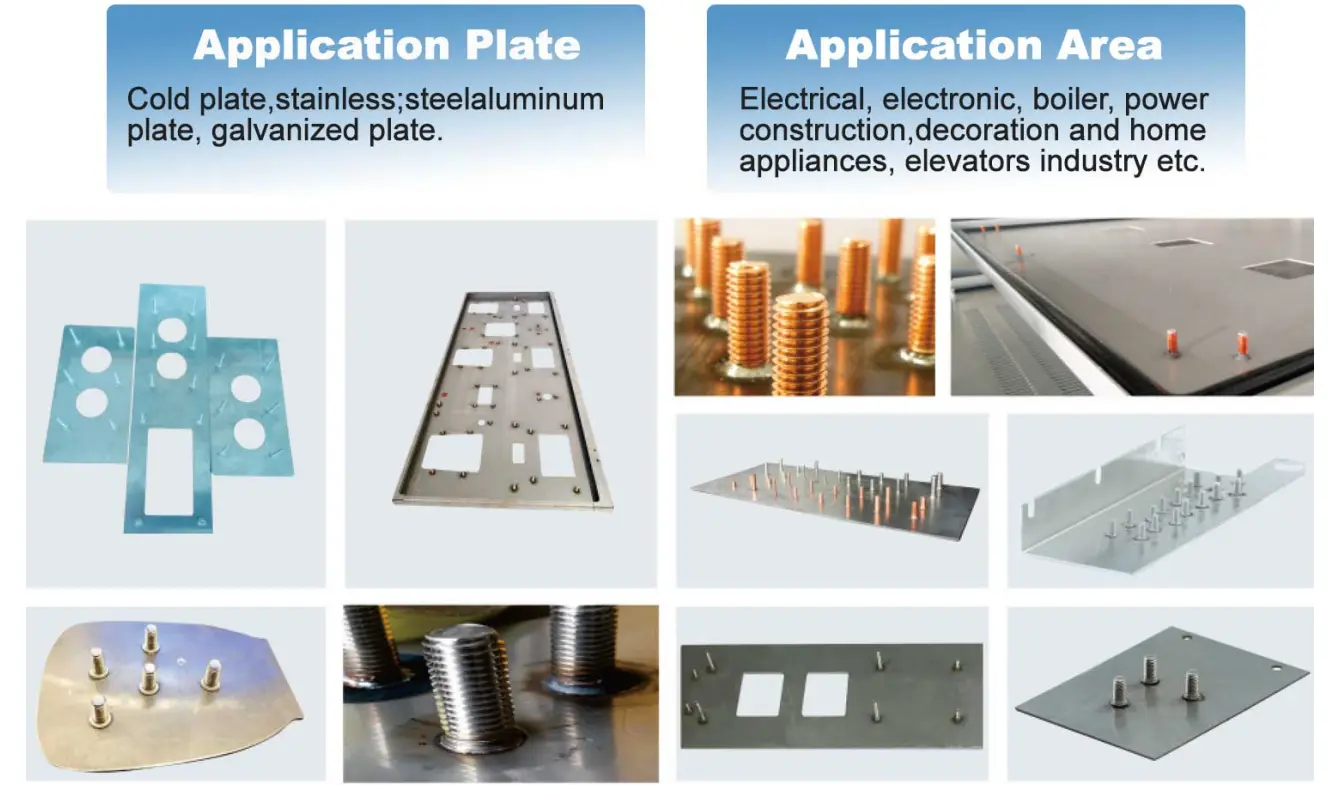
The RC-Z-2212 is applicable to carbon steel, stainless steel, aluminium sheet, galvanised sheet and other thin metal plates. The CD system employs Argon shielding gas to avoid oxidation throughout the weld cycle while welding aluminium.
Electrical enclosure fabrication
Welding grounding studs and mounting pins to the cabinet will protect the outer surface of galvanised or powder-coated steel cabinets. CD welding does not reverse-mark, leaving panel surfaces pristine for downstream coating or assembly.
Parts of an automobile body
Wire harness clips or interior trim fasteners may be installed uniformly across high-volume manufacturing runs on chassis or body panels.
New energy and HVAC equipment
Sheet metal components in these sectors often carry tight stud placement tolerances. The RC-Z-2212 handles these requirements without requiring custom fixtures for each part variant.
General sheet metal fabrication
Switchgear panels, junction boxes, industrial enclosures, and similar fabricated assemblies are common use cases for CNC Stud Welding Machines in job-shop and OEM production environments.
Quality and Inspection
Ruichuang's CNC stud welding systems include real-time process monitoring that tracks voltage discharge and plunge speed for every weld. Out-of-spec welds are flagged immediately, and the system maintains a production log for traceability.
For dimensional verification, stud placement accuracy can be confirmed through CMM measurement. Weld integrity testing methods applicable to this process include bend tests, tensile and torque tests, and ultrasonic testing for structural applications. The machine's grounding design and arc stabilization features are intended to maintain a centered arc and reduce arc blow risk.
Note: ISO 14555 and AWS D1.1 are mentioned here as applicable industry norms for stud welding inspection. Buyers should check what tests and documentation are necessary for their own quality systems.
Maintenance and Programming
An optional vibratory bowl feeder is provided and the feed rails need occasional cleaning to remove accumulation of metal particles. Periodic mechanical alignment checks are needed to ensure feeding accuracy for long production runs.
Standard G-code or CAD/CAM input is accepted for programming. Importing of DXF/DWG files is supported to directly generate weld coordinates. The majority of sheet metal manufacturing shops already have comparable CAD tools in place, thus there is no need for extra proprietary software.
FAQ
Q: What stud sizes are supported by the RC-Z-2212?
A: The system is capable of M2 to M10 studs, lengths from 5 to 210 mm. The configuration may be changed as per the needs of the workpiece.
Q:Can the machine weld multiple studs in a single automated cycle?
A:Yes. The CNC system stores multiple position coordinates in one program and executes the full welding sequence — positioning, feeding, and welding at each point — without operator intervention between welds.
Q:What base materials are compatible?
A:Carbon steel, stainless steel, aluminum sheet, and galvanized sheet are confirmed compatible materials. Argon shielding gas is used for aluminum welding.
Q:Is automatic stud feeding standard or optional?
A:Automatic vibratory bowl feeding is an available option. It eliminates manual stud loading and is typically selected for high-volume production lines.
Q:Which industries use the products most?
A:Electrical cabinet fabrication, automotive components, new energy equipment, HVAC units, and general sheet metal fabrication are the most common sectors.
Q:What is the practical difference between CD and Drawn Arc welding?
A:CD welding is used for thin materials and studs up to M10 where surface appearance matters. Drawn Arc welding applies to structural applications with larger stud diameters and higher penetration requirements.
Contact Us
Send your project requirements or technical questions to sales@lyrcautomation.com — We'll review your application for CNC Stud Welding Machines and follow up directly.