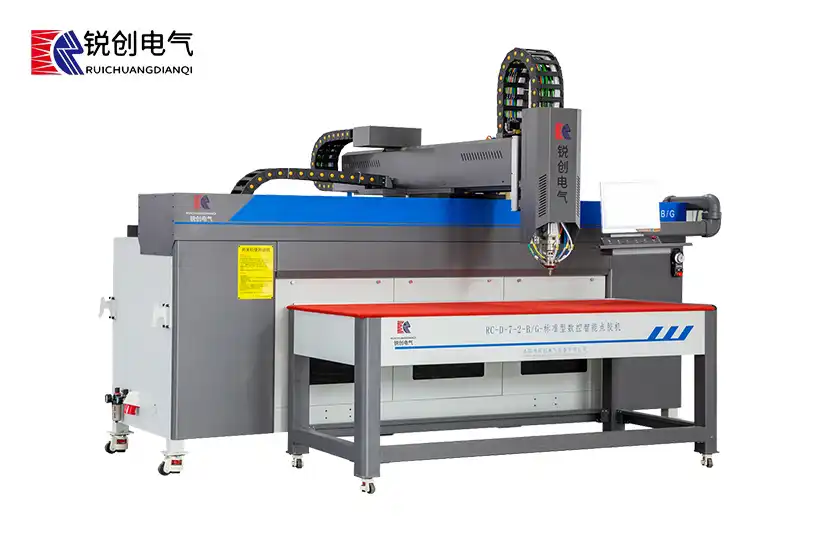
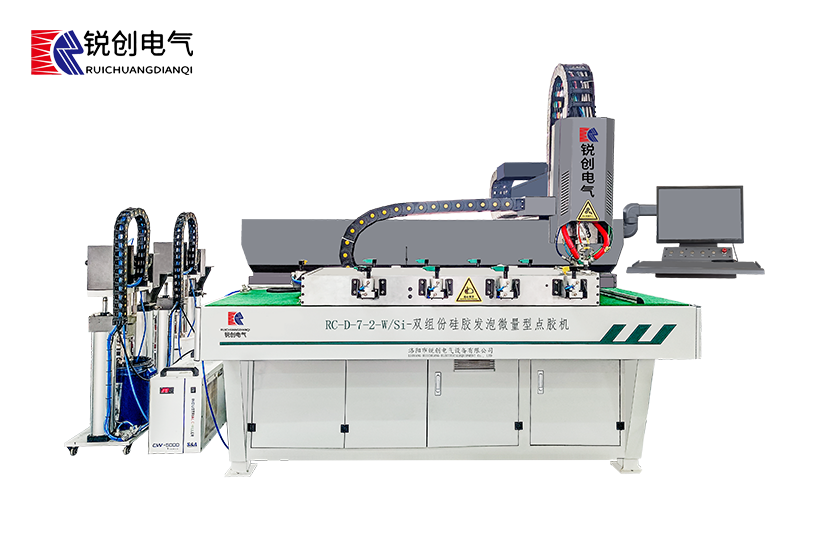
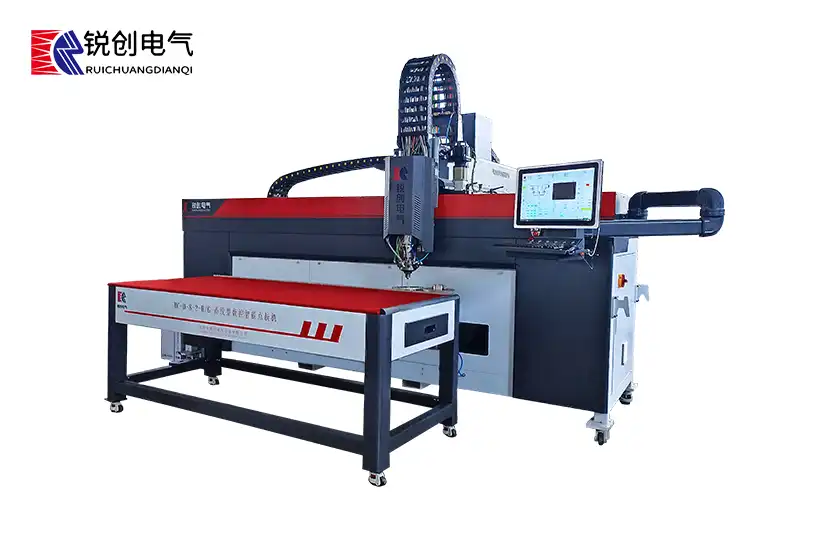
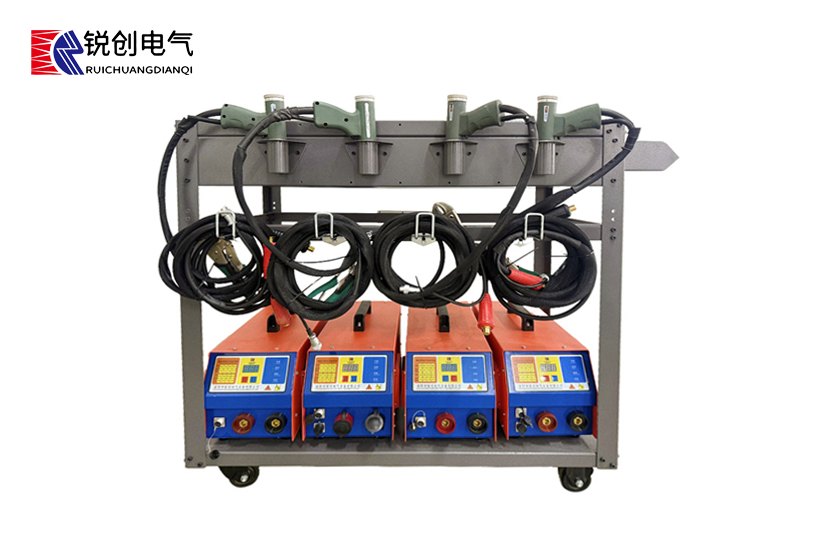
5-Axis Gantry CNC Grinding Machines
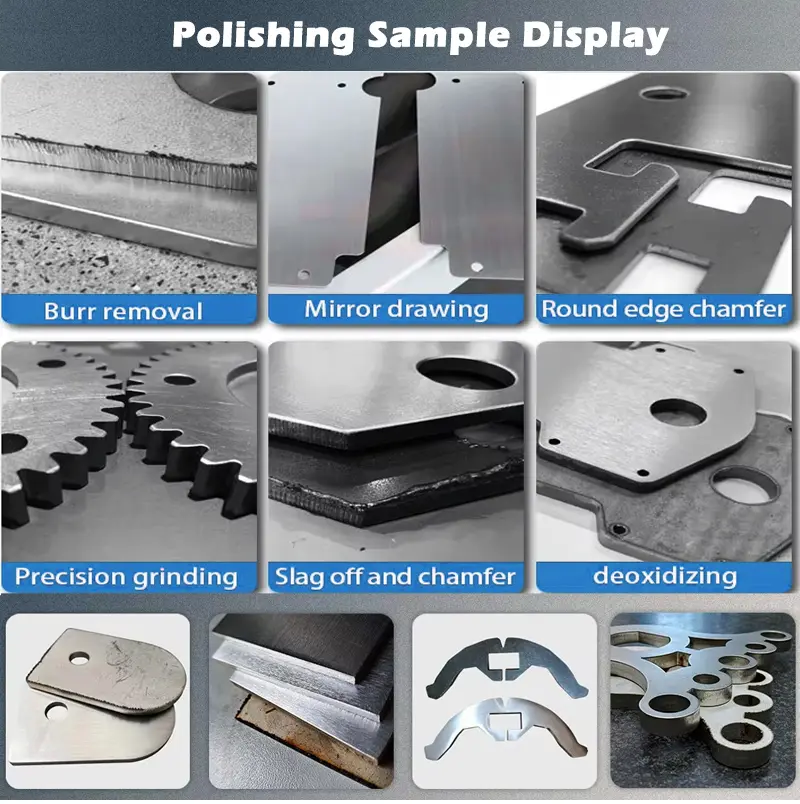
Processing Function: Grinding, Polishing, Edge Finishing and Surface Treatment
✅ 5-axis coordinated movement for complex surface processing
✅ Automatic grinding and polishing to replace manual operations
✅ Suitable for large-size and heavy metal components
✅ Stable processing quality with improved consistency
Applicable Materials: Carbon Steel, Stainless Steel, Aluminum and Other Metal Components
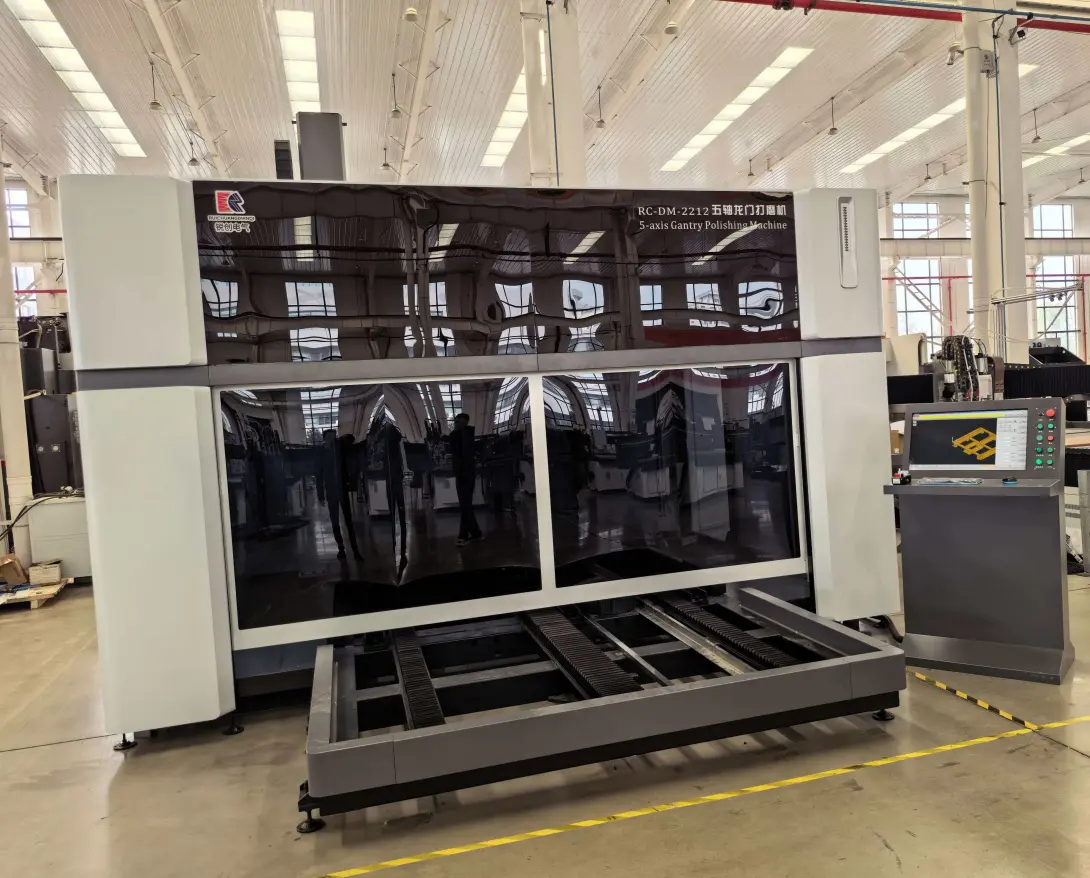
5-Axis Gantry CNC Grinding Machines for Large & Complex Metal Parts
5-Axis Gantry CNC Grinding Machines combine simultaneous X, Y, Z linear axes with two rotational axes (A/B or B/C) in a bridge-style gantry structure, enabling surface finishing of large, complex metal components in a single clamping. The platform has been positioned with an accuracy of less than ±0.002 mm/1000 mm and a repeatability of 0.001 mm. The normal surface roughness is in the range of Ra 0.2 to Ra 0.8 . Ra <0.1 μm is feasible under optimal grinding settings. Luoyang Ruichuang has been engaged in CNC machine tool development since 2002.
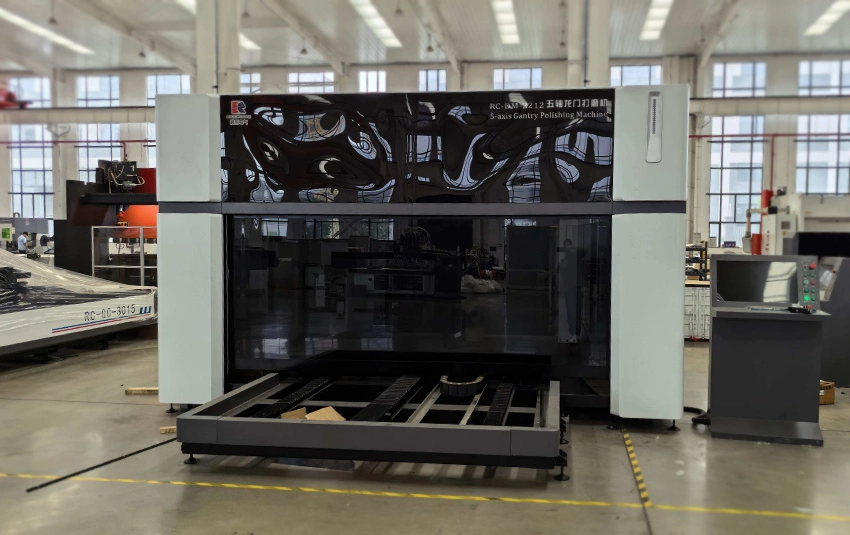
What Is a 5-Axis Gantry CNC Grinding Machines?
At the top of a gantry grinding machine is a bridge-shaped portal that moves over a fixed or moving worktable. While the piece being ground stays in place, the grinding head can move in any of five directions. The machine can get to deep holes, steep walls, complicated 3D curves, and sloped surfaces without having to move the piece being worked on.
On a normal 3-axis machine, angled surfaces and undercuts need to be re-fixedtured, and this is often done more than once for each part. This adds to the positioning error and makes the cycle time longer.
Five-axis interpolation reduces the number of intermediate setups, and hence fixture changes, and the dimensional risk associated with high value components.
Key Technical Specifications
| Parameter | Specification |
| Machine Model | RC-DM-2212 |
| X/Y/Z Axis Machining Range | 2200*1200*800mm |
| X/Y/Z Axis Motor Power | 1/1/1.5KW |
| C/A Axis Motor Power | 0.4/0.4KW |
| Spindle Speed | 6000-8000 |
| Machining Speed | 0~30m/min |
| Maximum Traverse Speed | 50m/min |
| Operation Mode | 3D Drawing Automatic Programming + Teach Programming |
| Working Voltage | 380V/50HZ |
| Drive Mode | Electric |
| Number of Control Axes | 5 |
| Rack Precision | N6 |
| Air Pressure | 0.8MPa |
| Bed Structure | Gantry Type |
| Clamping Method | Fixture Positioning |
| Dimensions (L×W×H/mm) | 4460*3570*3650 |
| Machine Weight | 2.0T |
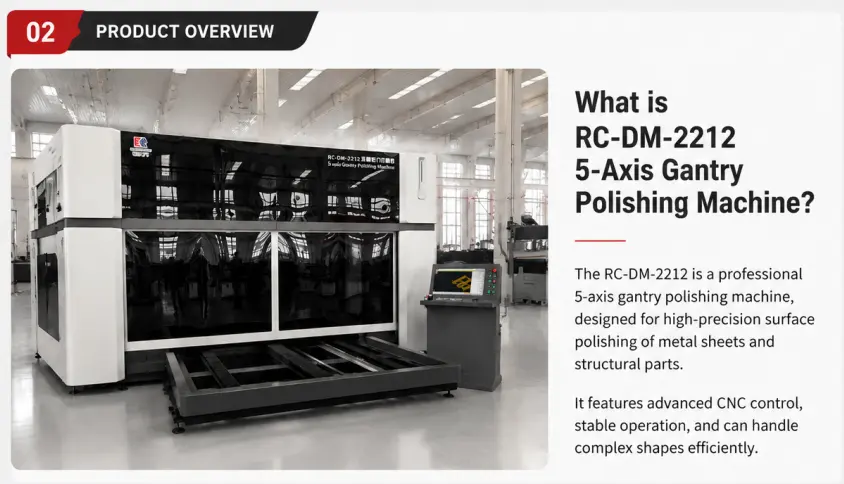
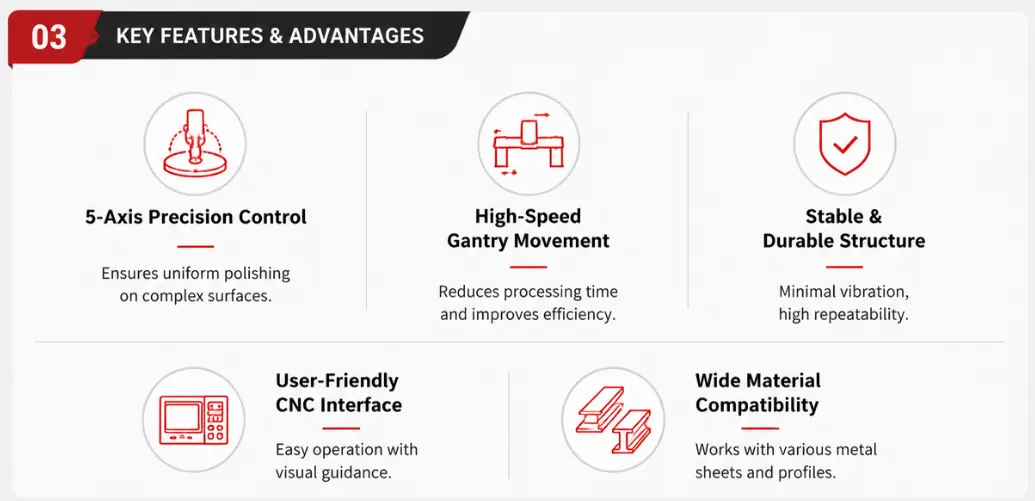
Core Structural Features
The symmetric gantry bridge design makes sure that the mass is evenly distributed on both sides. This gives the structure a higher natural frequency than a C-frame architecture and lowers yaw and roll errors during tough grinding operations.
The high-torque electro-spindle has built-in cooling to keep the spindle temperature stable during long production runs. This helps protect the surface structure of heat-sensitive metals like nickel-based superalloys.
When the gantry length is more than 10 m, sensors built into the machine casts are used with the active heat control software. With the help of chilled oil moving through ballscrews and guideways, heat buildup is stopped right away, instead of spreading out over a large area of the workpiece.
A closed-loop CNC control system constantly checks placement during each cycle. This keeps dimensional tolerances the same from batch to batch and gets rid of the need for humans to correct parts that aren't lining up correctly.
5-Axis vs. 3-Axis: Practical Differences
With a 3-axis machine, the grinding head moves only in straight linear directions. Any angled surface, curved cavity, or undercut requires re-fixturing — sometimes multiple times for a single part.
With 5-axis linkage, the grinding head tilts and rotates freely, allowing multi-sided grinding in one clamping. Practical consequences include:
- No re-clamping errors between setups
- Lower fixture cost per job
- Shorter production cycle per part
- Better surface transition quality between adjoining faces
For molds, turbine blades, and precision structural components, completing these features in one setup is often a process requirement rather than an option.
Application Industries
5-Axis Gantry CNC Grinding Machines are used across several precision manufacturing sectors.
Aerospace & Turbine Manufacturing — Simultaneous grinding of complex fir-tree root profiles and curved blade surfaces on large-diameter engine turbines. Nickel-based superalloys require controlled material removal rates with careful thermal management.
Mould & Die Industry — Hardened steel automobile dies with deep holes and steep walls may be ground in a single setup, decreasing the number of hand polishing procedures between the machined and final condition.
Optical & Semiconductor – Precision grinding of large ceramic or glass-ceramic vacuum chucks and mirror substrates where surface integrity and flatness tolerances are strictly regulated.
Automotive & New Energy – Large die-cast moulds, gear profiles, precise structural plates for body and powertrain components.
Marine & Heavy Machinery – Large composite material tooling and precise structural components requiring dimensional accuracy over long part lengths.
Quality Control & Testing Protocol
Each machine goes through a documented inspection sequence before delivery:
- Laser Interferometer Calibration — Measures linear positioning accuracy and pitch/yaw errors across the full travel range
- Renishaw Ball-Bar Testing — Verifies 5-axis kinematic synchronization and circularity, identifying lag in rotational axes
- Thermal Stability Analysis — Infrared sensors monitor spindle nose displacement during extended operation cycles
- Grinding Burn Detection — Barkhausen Noise analysis on test pieces checks that cooling and feed parameters do not affect workpiece metallurgical integrity
- Static and Dynamic Stiffness Tests — Gantry deflection under maximum grinding load is verified against finite element analysis correlation data
These tests confirm compliance with ISO 230-2 and ISO 10791 before shipment.

Software & Toolpath Considerations
Full performance needs dedicated 5-axis CAM software with a grinding-specific post-processor. The post-processor must automatically compensate for wheel wear and perform dressing cycles to ensure uniform stock removal.
Real-time look-ahead interpolation of the CNC controller provides smooth feed rates on complicated curved toolpaths. And without it, the feed rate change at tight-radius transitions might create noticeable traces on the completed surface.
For dry grinding applications such advanced ceramics or composite materials, the machine may be equipped with dust extractor devices instead of high-pressure coolant.
Maintenance & Long term Operation
To maintain the Tool Center Point (TCP) correct, a kinematic calibration is advised after 2000 hours of operation or after any minor crash. This prevents drift in the home locations of the A/B axis from building up to part dimensional inaccuracies over time.
Luoyang Ruichuang provides an after-sales service team for technical support, troubleshooting, and preventive maintenance. CNC operation and PLC programming training is available through the Luoyang Ruiling Automation Training Center.
FAQ
Q: What types of workpieces can this machine process?
A: It is suited for big and complicated components such as mould steel dies, die-cast moulds, turbine blades, composite material moulds, huge gear profiles and precision structural plates.
Q: What is the practical benefit of 5-axis linkage against 3-axis grinding?
A: The grinding head may be tilted and rotated with five axis connection to complete 3D curved surfaces, inclined planes and deep hollow profiles in one clamping. This avoids re-clamping processes and thereby related positioning mistakes.
Q: What surface finish and accuracy can be expected?
A:Positioning accuracy is within ±0.002 mm/1000 mm. Standard surface roughness is Ra 0.2–Ra 0.8, with Ra <0.1 μm achievable under optimized conditions.
Q: Can the gantry travel be customized?
A:Yes. Gantry travel is configurable. Multiple travel sizes are available to accommodate large molds and heavy workpieces with varying load requirements.
Q: Which industries use the product most frequently?
A:Mold manufacturing, aerospace, automotive, new energy, marine equipment, composite tooling, and precision heavy machinery commonly rely on this machine type for complex surface work.
Q: Does the machine support both wet and dry grinding?
A:Yes. The standard configuration uses high-pressure coolant for thermal control during wet grinding. For dry applications such as advanced ceramics or composites, the machine can be fitted with dust extraction systems.
Contact Us
For technical specifications or to discuss your application, contact our team at sales@lyrcautomation.com. We welcome inquiries about configuration and customization options for 5-Axis Gantry CNC Grinding Machines.