How to Choose the Right Sealant Dispensing Machine for Electrical Cabinets?
Choosing the right sealant dispensing machine for electrical cabinets starts with understanding your production scale, sealant type, and precision requirements. A well-matched dispensing system applies silicone, polyurethane, or MS adhesive with consistent bead width and volume, protecting cabinet interiors from moisture and dust ingress. For OEM manufacturers and procurement engineers, the decision involves evaluating dispensing technology, material compatibility, cycle time, integration capability, and supplier support. This guide walks you through each factor so you can make a confident, informed purchase that aligns with your quality standards and output goals.
Understanding Sealant Dispensing Machines and Their Role in Electrical Cabinet Production
To meet IP54 or IP65 ingress protection grades, electrical cabinets must have tight, constant seals. That consistency is much more likely to be achieved by a foam gasket machine or an automated adhesive applicator than by hand. This is what you need to know about how a sealant dispensing machine really works and why automated dispensing can improve sealing consistency.
How the Dispensing Process Protects Electrical Components
A controlled bead of sealant is put on the cabinet lip by a dispensing device. The bead turns into a seal when the lid closes, keeping dust and moisture out. The final seal's ability to pass IP testing depends on how well the bead's width, height, and volume are maintained.
FIPFG Technology and Its Advantage in Cabinet Sealing
Form-In-Place Foam Gasket (FIPFG) technology uses a polyurethane foam with two parts that cures and expands right on the part. The end result is a seal that fits perfectly and smooths out any rough spots on the surface. Frost & Sullivan released a report in 2022 on industrial sealing trends. The use of FIPFG in enclosure manufacturing increased by 18% year-over-year as die-cut gaskets were replaced to cut down on waste and improve the reliability of the seal.
From Manual Application to Automated Dispensing
When beads are put on by hand, they have thickness errors of ±2 mm or more. Automated filling systems get accuracy of ±0.3 mm or better, which cuts down on waste and extra work. For electrical cabinet lines that run 200 or more units per shift, the savings in labor and improvements in quality make the capital investment worthwhile within a reasonable amount of time.
Core Criteria to Consider When Choosing a Sealant Dispensing Machine for Electrical Cabinets
If you choose the wrong machine, you could end up with uneven cycle times, seals that don't work together, or expensive repairs. The following factors will help you cut down your choices in a useful way.
Dispensing Technology: Pneumatic vs. Electric vs. FIPFG
For single-component silicone and PU coatings, pneumatic devices are used a lot. They don't cost much and are easy to keep up. Electric servo-driven systems can control pressure more precisely and are best for uses that need accurate mass accuracy. When a formed-in-place seal is needed on cabinet flanges or container lids, FIPFG systems are the best option because they are made for two-component PU foam.
Sealant Compatibility and Viscosity Range
When selecting a sealant dispensing machine, make sure it is compatible with the sealant used in your application. Different cabinet makers use silicone (low viscosity, about 5,000 to 50,000 cps), polyurethane (medium viscosity), or MS polymer sealants. Make sure that the type of pump in the machine (gear, piston, or progressive cavity) can handle the thickness of your sealant without breaking down. Machines with temperature-controlled material paths help keep flow rates steady even when the weather changes from season to season.
Cycle Time and Production Volume Alignment
Match the cycle time of the machine to your takt time. Most cabinet production situations can be handled by a machine that can handle parts in 10 to 60 seconds. If your line has more than one cabinet size, look for a machine with programmable multi-path recipes. This way, workers can easily switch between part plans without having to retool each one by hand.
Evaluating Quality, Service, and Supplier Credentials
How well equipment works after five or ten years depends just as much on the support infrastructure of the supplier as it does on the machine's original specs. A reliable partner is different from a transactional seller in the following ways:
Certifications and Quality Documentation
CE marking shows that the product meets European safety standards for machinery, while ISO 9001 approval shows that the company has a structured quality management system. If a dealer gives First Article Inspection (FAI) reports and material tracking paperwork to cabinet makers who work with cars or send a lot of their products, audit risk is greatly reduced.
After-Sales Support and Response Time
Find out how quickly potential suppliers can fix technical problems. Many problems can be fixed quickly with remote help through video or PLC data upload. On-site commissioning and operator training make it easier to get big automation projects up and running. As part of its standard after-sales package, LYRC Machine offers remote technical support, installation support, operator training, software updates, and spare parts supply. For bigger projects, on-site service is also available.
Delivery Lead Times and Customization Capability
Standard machines usually get shipped between 15 and 30 business days. Customized configurations, like changing the working areas, choosing specific valve types, or adding a robot, usually take 30 to 60 working days. Get written confirmation of wait times before making a commitment, especially for project-driven procurement where delays can lead to fines for line startup.
Comparing Dispensing Systems: Making an Informed Decision
Once you have chosen two or three systems, an organized comparison will keep you from having to return them later. To compare them side by side, here are the core dimensions:
Ruichuang Model RC-D-6-2-B/J: A Practical Reference Point
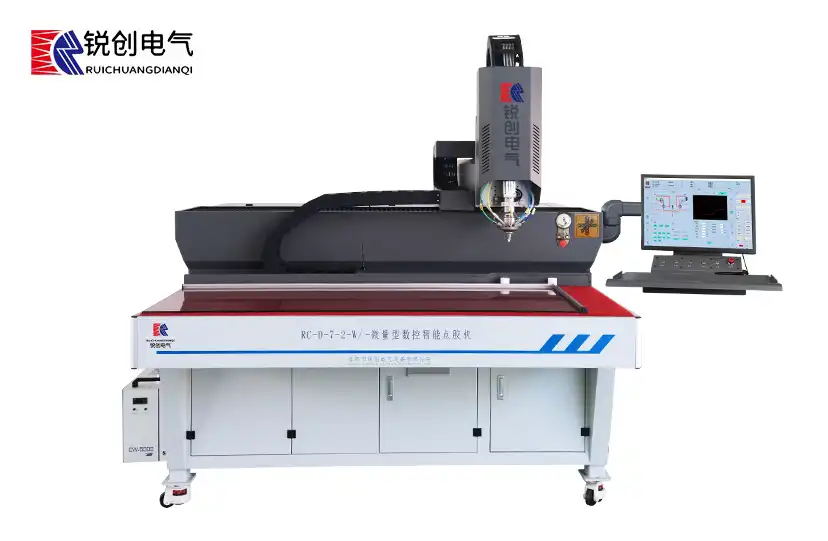
The RC-D-6-2-B/J sealant dispensing machine uses FIPFG technology and a two-component PU foam material. The work area is 2,450 mm x 1,250 mm x 330 mm, and the seal width can be changed from 5 mm to 30 mm. The work area is 2,450 mm x 1,250 mm x 330 mm, and the seal width can be changed from 5 mm to 30 mm. For electrical cases, car parts, EV battery packs, and industrial enclosures, it was made. The machine is certified by both CE and ISO 9001. Here are some of the best things about this device:
- Compact and space-saving design: The machine fits into constrained floor plans without sacrificing output quality, making it practical for factories that cannot dedicate large footprints to a single workstation.
- Stable operation and low maintenance burden: Built on a proven dispensing platform, the system operates with minimal operator intervention. Maintenance access is straightforward, reducing scheduled downtime.
- Automated PU foam gasket forming: The machine automatically dispenses and forms the gasket bead in a single continuous pass, eliminating the handling steps associated with pre-cut gasket insertion.
- Cost-effective FIPFG solution: It delivers the performance characteristics of FIPFG sealing—conforming gaskets, consistent compression, and reliable IP ratings—without the overhead of a large-scale system.
The two biggest problems in cabinet sealing production that these benefits directly address are the uneven shape of the beads that come from hand methods and the high cost per unit of pre-formed seals. Since 2002, LYRC Machine has built automation systems around this kind of useful tech, putting process integration ahead of just selling machines.
Total Cost of Ownership Beyond the Purchase Price
Think about how much it costs to replace things like PU two-component material and mixing tools, how much energy it uses, how often it needs to be maintained, and how much it costs to have unexpected downtime. A machine that costs less up front but needs imported parts that take a long time to get can end up costing a lot more after three years.
Integration with Existing Production Lines
Make sure the machine works with the PLC transmission methods your company already uses. Common ones are Modbus, EtherCAT, and Profinet. Integration with upstream conveyor systems or downstream inspection stations gets rid of the need for human transfer steps and makes it easier to track down production data.
Practical Tips for Installation, Calibration, and Maintenance
Setting up the machine properly from the start will save you weeks of problems later. No matter which system you choose, the following tips will always be useful.
Site Preparation and Environmental Controls
Place the machine on a flat surface that is away from things that might cause vibrations. To keep PU foam material within its working window, keep the room temperature between 15°C and 30°C. It is best to control the temperature and humidity in the area where the foam is being dispensed if the humidity is above 70%.
Calibration Procedures for Consistent Bead Output
Use a weigh scale or bead width gage to do calibration shots at the start of every shift. Compare the results to the map you used as a guide. If readings go outside of your tolerance band, change the pressure or pump speed. This easy process finds changes in material flow before they cause parts to break.
Preventive Maintenance Schedule
As suggested by the maker, mixing nozzles should be replaced every 50 to 200 shots, but this can vary based on the material's pot life. Check the pump seals once a month and clear the material path at the end of each shift to keep cured residue from building up. An official maintenance log helps with ISO 9001 audits and makes machines last longer.
Conclusion
Choosing the right sealant dispensing machine for electrical cabinet production affects the quality of the finished goods, the speed of the production line, and the long-term costs of running the business. Choose the right technology (FIPFG, gas, or electric) based on the type of sealant, the shape of the cabinet, and the cycle time you need. Check the supplier's credentials, infrastructure for support, and delivery promises before you sign a purchase order. The RC-D-6-2-B/J machine shows that small, low-cost FIPFG options can meet tough output needs without sacrificing quality. Take the time to test a few samples, look over good literature, and compare the total costs of ownership of the products on your choice.
FAQ
What sealant types are compatible with automated dispensing machines?
Silicone, polyurethane, and MS polymer sealants can be used with most systems. For FIPFG machines and other two-component PU foam systems to work, they need a dual-metering pump and either a static or dynamic mixing tube. Before you buy a machine, you should always check the specification sheet to see if the material density and pot life match up.
Can a dispensing machine integrate with an existing conveyor line?
Yes, machines that work with PLC communication methods like Modbus or EtherCAT can get signals from sensors on the conveyor belt and send signals to places further down the line when the work is done. During your expert review, make sure you understand the exact procedure.
How do I verify that the gasket will meet IP65 requirements?
After changing the shape of the beads, test the sample cabinets for pressure decay or water ingress. The two most important factors are a consistent bead width (within ±0.3 mm) and enough foam expansion. As part of your FAI process, write down the findings.
What maintenance does a FIPFG system require?
It is standard to replace the mixing nozzle every day, clear the material line once a week, and check the pump seal once a month. Keep a repair log to help with quality checks and to spot early signs of wear.
How long does commissioning typically take?
With a trained technician on site, standard tools can be put to use in one to three days. Customized systems with robots or conveyors may take five to ten days, which includes training for the operators.
Connect with Ruichuang for Your Next Dispensing Project
Our team at Ruichuang (LYRC Machine) has been automating the making of sheet metal since 2002, so we know a lot about the process. We can help you with ODM/OEM design, CE and ISO 9001 certification, and global shipping, whether you need a basic Sealant Dispensing Machine or a fully integrated foam gasket line for electrical cabinets. You can email us at sales@lyrcautomation.com to ask for a sample evaluation or project consultation right away.
References
Frost & Sullivan. (2022). Global Industrial Sealing and Gasketing Technology Trends Report. Frost & Sullivan Research & Analysis.
International Electrotechnical Commission. (2013). IEC 60529: Degrees of Protection Provided by Enclosures (IP Code). IEC Publication.
Society of Manufacturing Engineers. (2021). Adhesive and Sealant Dispensing in Automated Assembly. SME Technical Publication Series.
Henkel AG & Co. KGaA. (2023). Form-In-Place Gasket Solutions for Industrial Enclosures: Application Guide. Henkel Industrial Adhesives Division.
International Organization for Standardization. (2015). ISO 9001:2015 Quality Management Systems — Requirements. ISO Publication.
European Committee for Standardization. (2006). EN 13980: Potentially Explosive Atmospheres — Application of Quality Systems. CEN Technical Report.